Spectrum · The part nobody sees
The same band is not the same band
The ITU divides the world into three regions with different allocations, which is why the same handset supports different bands in different markets.
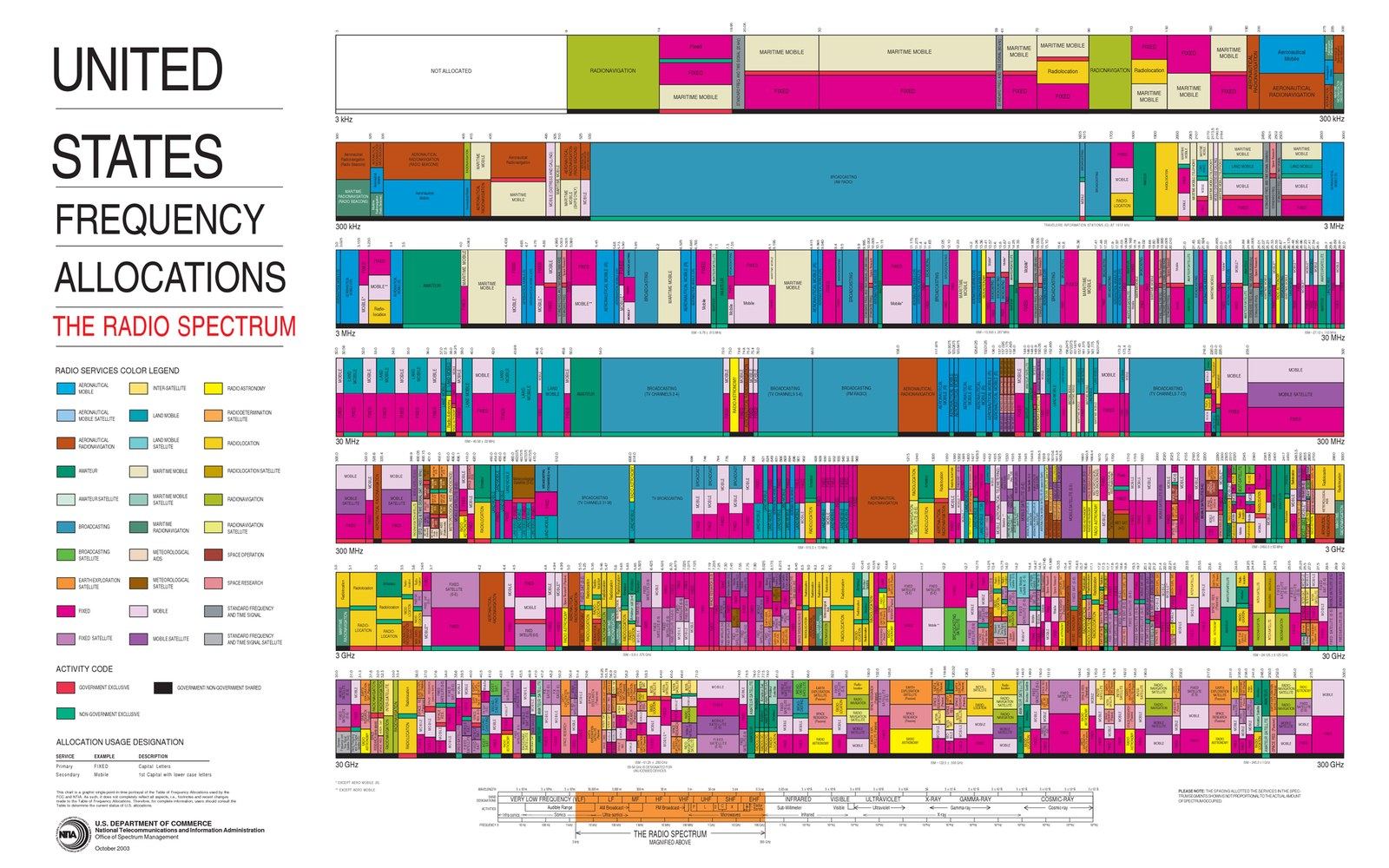
Three ITU regions, dozens of national regulators, one device — the reason band lists on a spec sheet run to forty lines.
The world in three slices
The International Telecommunication Union does not run the world's radio spectrum, but it does draw the map everyone else colours in. Since 1927, in one institutional form or another, the ITU has maintained the Radio Regulations, a treaty-level document that partitions the usable radio spectrum by service type and, critically, by geography. That geography resolves into three ITU regions, whose boundaries were fixed in their current form at the 1979 World Administrative Radio Conference and have survived every revision of the Radio Regulations since.
Region 1 covers Europe, Africa, the Middle East as far east as the Persian Gulf, and the former Soviet states — a bloc that includes Ofcom in the United Kingdom and the frequency coordinators of every EU member state, whose work is harmonised at the European level by ETSI and the European Conference of Postal and Telecommunications Administrations. Region 2 is the Americas, where the FCC sets domestic rules for the United States and the Inter-American Telecommunication Commission does regional coordination. Region 3 is Asia-Pacific, an enormous and internally varied zone running from Iran eastward through China, Japan, Australia and the Pacific island states. Each region gets its own column in the ITU frequency allocation table, and the entries in those three columns frequently differ.
The ITU's own explanation of how the Radio Regulations allocate spectrum is a starting point, but the real substance lives in the allocation tables themselves — and in the footnotes, which run to hundreds of entries and are where the practical divergence between regions actually lives.
Chronology of key divergence events
- 1927ITU predecessor body begins formal spectrum coordination
- 1979World Administrative Radio Conference fixes the three-region boundary structure still in use
- 2008US spectrum auction clears 700 MHz for LTE (Bands 12/13/14/17); European 700/800 MHz digital dividend follows on a different segment
- 2020 (April)FCC opens full 5925–7125 MHz (1200 MHz) for unlicensed Wi-Fi 6E use
- 2021EU opens 5925–6425 MHz only (500 MHz) for Wi-Fi 6E; upper 6 GHz remains contested in Region 1
How allocations diverge in practice
A frequency allocation is a permission: it says that a given service — Fixed, Mobile, Broadcasting, Radiolocation — may operate in a given band in a given region. A primary allocation has precedence; a secondary allocation must accept interference from primary users and may not cause it. When the ITU table shows "Mobile" as primary in Region 2 but only secondary in Region 1, the practical consequence is that Region 1 administrations are unlikely to license that band for cellular use, because the incumbent primary service there — often a Fixed or Aeronautical service — cannot legally be disturbed.
That divergence is old, but it became commercially acute once cellular networks started consuming spectrum in large slices. The bands that 3GPP defines for LTE and 5G NR are drawn from whatever the relevant regional allocation permits. A band that exists in the 3GPP specification is not therefore available in every country; it merely means at least one administration somewhere has licensed it. The 3GPP band numbering for LTE spans over 70 distinct frequency bands defined across all three ITU regions, and 5G NR adds its own FR1 (sub-6 GHz) and FR2 (millimetre-wave) band list on top.
The 700 MHz band illustrates the problem cleanly. In Region 2, the 698–806 MHz segment was cleared from television broadcasting following the United States' digital switchover and the subsequent spectrum auction in 2008, creating the bands that became LTE Band 12, 13, 14 and 17. Region 1 administered its own digital dividend at a different frequency: the 790–862 MHz segment, which became LTE Band 20, widely deployed across Europe. A handset designed solely for the US market and carrying only Band 12/13/17 support will find no compatible LTE signal in most of Europe, even though both networks are nominally "700 MHz LTE." The digits are similar; the actual frequencies do not overlap.
The 2.6 GHz band shows a subtler variant of the same problem. The core segment, roughly 2500–2690 MHz, is used for LTE Band 7 across much of the world, but the guard-band arrangements, duplex spacing and exact upper and lower edges differ between administrations, meaning that band compatibility at the chipset level requires careful attention even when two countries have agreed on the same general frequency neighbourhood.
The 6 GHz opening and its regional fractures
The 6 GHz band — nominally 5925 to 7125 MHz — has become the sharpest recent example of regional divergence shaping real hardware. The FCC opened the full 1200 MHz of this range for unlicensed use in April 2020, a decision that shaped what Wi-Fi 6E devices could advertise in the US market. The European Union, through its Radio Spectrum Committee and ETSI, followed in 2021 but with a more restricted opening: 5925–6425 MHz, the lower 500 MHz only. Several Asia-Pacific administrations have opened portions of the band, others have opened nothing, and the upper portion above 6425 MHz remains contested in several Region 1 countries because of incumbent Fixed Service and satellite earth-station allocations that were never cleared.
A Wi-Fi 6E access point sold in the United States and one sold in Germany both carry the "Wi-Fi 6E" certification from the Wi-Fi Alliance, but the US device has access to more than twice as much spectrum. The hardware inside may be nearly identical; the firmware and the regulatory domain code loaded onto it determine which channels are actually available. This is not a marketing fiction — it is a direct mechanical consequence of the ITU allocation table and what each administration did with their column in it. Wi-Fi 7's widest channels require the upper portion of the 6 GHz band, which means that in markets where only the lower 500 MHz has been opened, some of the standard's headline capabilities simply cannot be exercised.
What the spec sheet is actually saying
A modern flagship smartphone supports, as of 2025, something in the range of 30 to 50 distinct cellular bands depending on the market variant. That number is not marketing padding. Each band on the list is a specific set of uplink and downlink frequencies, a duplex mode (FDD or TDD), a channel raster and a maximum power class, all of which have to be independently validated against the regulatory rules of every administration where the device will be sold. The ITU's Radio Regulations establish the framework; national regulators and their type-approval processes enforce it at the device level.
The RF front end — the filters, power amplifiers, low-noise amplifiers and switches between the antenna and the baseband chip — has to implement all of those bands simultaneously in a chassis that leaves no room for separate hardware per band. Band aggregation under LTE-Advanced and 5G NR makes the filter problem worse: a device combining two or more bands simultaneously has to suppress intermodulation products that appear at frequencies close to, and sometimes inside, other bands the device is also trying to receive. The filter count in a high-end RF front end now runs to dozens, one of the less visible engineering consequences of the ITU's three-column world.
The practical result of this complexity is that "global" device variants — the ones that carry nearly every defined band — cost more to build than regional variants, because the RF front end is larger and the validation process is longer. Carriers and manufacturers often release region-specific SKUs to keep those costs manageable, which is why the same model number bought in one market may quietly lack bands present in the version sold in another. The ITU did not intend to drive that outcome. It is the accumulated effect of seventy years of independent regional decisions, each locally rational, all globally legible only to an engineer reading a very long spec sheet.
It is the accumulated effect of seventy years of independent regional decisions, each locally rational, all globally legible only to an engineer reading a very long spec sheet.
The three ITU regions
- Region 1 — Europe, Africa, Middle East to the Persian Gulf, former Soviet states; European coordination via ETSI and CEPT
- Region 2 — The Americas; US domestic regulation by the FCC; regional coordination by CITEL
- Region 3 — Asia-Pacific; the largest and most internally varied bloc; no single regional coordination body with equivalent authority to CEPT
Key distinctions for hardware engineers
- Band number vs. frequency — a 3GPP band number is a specific uplink/downlink pair; two "700 MHz" bands may share no actual frequencies
- FDD vs. TDD — paired spectrum (FDD) and single-band time-division (TDD) require different duplex filter architectures
- Regulatory domain code — firmware parameter that restricts available channels to those permitted by the relevant national administration
- SKU fragmentation — regional hardware variants, differing in RF front-end filter sets, driven by the cost of supporting every band in a single device
Read next
The rest of the part nobody sees
- SpectrumThe unlicensed slice everything crowds intoThe ISM bands were set aside for industrial, scientific and medical use, and Wi-Fi, Bluetooth and Zigbee all share them by accident of that allocation.
- SpectrumGovernments sell the airNational spectrum auctions have raised sums comparable to infrastructure budgets, and the price paid shows up in what carriers build.
 SpectrumA band two industries both wantedOpening 6 GHz for unlicensed use was contested by incumbent licensees, and different regulators resolved it differently.